
Trump Account for Children: A Chartered Accountant’s Guide to the New Government-Backed IRA Program

Trump Account for Children: A Chartered Accountant’s Guide to the New Government-Backed IRA Program Trump Account for Children: What Families and Advisors Need to Know The Working Families Tax Cuts Act has introduced a new and highly structured savings vehicle for minors—the Trump Account. While the name attracts attention, the substance of the program deserves serious consideration from families, employers, and financial advisors alike. This account represents a long-term policy shift toward early financial security for children, and understanding it early allows families to plan efficiently while staying compliant. What Is a Trump Account? A Trump Account is a newly authorized form of traditional individual retirement account (IRA) established exclusively for the benefit of a child. The account is owned by the child Managed by a parent, guardian, or authorized individual until the child turns 18 Governed by specific rules outlined in legislation and Form 4547 instructions Unlike standard IRAs, Trump Accounts are intentionally restrictive during the accumulation phase to ensure long-term growth and policy discipline. Investment and Contribution Rules During the growth period (from account opening until December 31 of the year before the child turns 18): Contributions are non-deductible Investments are restricted to: Broad U.S. equity index mutual funds, or U.S. equity index ETFs Contributions are separate from all other IRAs Withdrawals are generally prohibited Permitted distributions are limited to: Rollovers Correction of excess contributions Distribution due to the child’s death These rules emphasize long-term capital appreciation over short-term liquidity. Government’s $1,000 Pilot Contribution: Eligibility Criteria The pilot program provides a one-time $1,000 government deposit for eligible children, subject to strict conditions: A child must: Be expected to qualify as a dependent for the election year Be born after December 31, 2024 and before January 1, 2029 Not have previously received a pilot contribution Be a U.S. citizen with a valid Social Security number The election is made using Form 4547, and the Treasury will fund the account only after it is confirmed as open. Important: No government deposits will be made before July 4, 2026. Families may still open a Trump Account even if the child does not qualify for the $1,000 pilot contribution. Additional $250 Contribution for Lower-Income ZIP Codes In December 2025, a significant philanthropic commitment expanded the program further: 25 million children Living in ZIP codes with median incomes below $150,000 Will receive an additional $250 contribution, on top of the $1,000 government seed For many middle-income families, this early infusion can materially improve long-term compounding outcomes. Employer Contributions: Compliance Considerations While employer participation may enhance benefits, it also introduces: Payroll reporting implications Coordination with employee benefit structures Additional tax and compliance oversight For businesses already managing evolving reporting standards, professional guidance is essential to avoid misclassification or compliance gaps. How Families Should Get Started From a planning and advisory perspective, the following steps are recommended: Confirm eligibility Review birth year, citizenship status, and Social Security documentation. Designate the authorized individual Decide who will make the election if multiple parties qualify. Plan for mid-2026 execution Elections are expected to open online around that time. Structure contributions strategically Consider annual contribution levels and employer participation. Integrate with broader financial planning Trump Accounts should complement—not replace—existing education and retirement strategies. Why Professional Advice Matters Trump Accounts offer a rare advantage in financial planning: time. However, the value of that time depends on: Correct elections Proper account setup Compliance with contribution and investment rules Alignment with tax and estate planning goals For families and employers, early consultation with a Chartered Accountant or tax advisor can prevent missed benefits and future compliance issues. Final Thoughts The Trump Account is not a headline gimmick—it is a structured, government-backed savings mechanism with long-term implications for family wealth planning. Handled correctly, it can meaningfully improve a child’s financial starting point. Mishandled, it risks becoming an underutilized or non-compliant account. Now is the right time to understand the framework, plan ahead, and seek professional guidance.
Why Outsourced Accounting Is a Game-Changer for US Small Businesses
Why Outsourced Accounting Is a Smart Move for UK Startups (and How to Choose the Right Partner) Starting a business in the UK is an exciting journey — but managing your finances effectively shouldn’t hold you back. For many startups, especially in their early stages, handling accounting and bookkeeping in-house can become a major drain on time, money, and energy. That’s where outsourced accounting comes in — a cost-effective, flexible, and strategic solution that helps startups focus on growth. 1. Save Money — Without Sacrificing Quality For startups, every pound counts. Hiring a full-time accountant means paying salaries, benefits, pensions, training, software licenses, and often providing office space. Outsourced accounting lets you convert these fixed costs into flexible service fees. Instead of paying for a whole team, you only pay for the services you need — and often at a much lower cost. Outsourced providers often deliver professional expertise at a fraction of the cost of an internal team, helping save your startup tens of thousands of pounds annually — money that can be reinvested into product development, marketing, or scaling operations. 2. Gain Access to Specialist Expertise Startup founders are experts in their product or service — not necessarily in UK tax law, VAT regulations, or financial compliance. Outsourced accounting puts you in direct contact with professionals who specialise in accounting, taxation, and compliance. These experts stay up-to-date with complex UK financial regulations (like HMRC requirements and Making Tax Digital standards) and ensure your books are accurate, compliant, and audit-ready. This eliminates costly mistakes, missed deadlines, or penalties that can arise from inexperience. 3. Scalable Support That Grows With Your Business Startups grow fast — but their accounting needs don’t always follow a steady pattern. Some months require more support (e.g., tax season), while others are quieter. Outsourced accounting gives you the flexibility to scale services up or down on demand, without the burden of hiring or laying off staff. Whether you need basic bookkeeping at launch or advanced financial forecasting as you expand, your provider can adjust to your evolving requirements with ease. 4. Free Up Time to Focus on What Matters Time is one of the most precious resources a founder has. Every hour spent wrestling with spreadsheets or deciphering HMRC guidance is an hour taken away from product innovation, customer acquisition, or fundraising. With outsourced accounting handling the books, tax filings, payroll, and compliance, you can focus on your core business strategies and growth initiatives. 5. Leverage Advanced Accounting Technology Outsourcing accounting isn’t just about people — it’s also about technology. Reputable providers use leading cloud accounting platforms and automation tools (like Xero, QuickBooks, or FreshBooks) that most startups would find expensive or complex to implement in-house. These technologies improve accuracy, provide real-time financial insights, and enable seamless collaboration — all from anywhere with an internet connection. How to Choose the Right Outsourced Accounting Partner Not all providers are created equal. Here’s how to find one that fits your startup’s needs: Look for Industry Experience Choose a partner familiar with startup finances and UK regulations such as SEIS/EIS tax schemes, VAT, R&D tax claims, and more. Providers with this background can offer tailored advice, not just basic services. Prioritise Clear Communication Your accounting partner should explain numbers in plain English and keep you informed regularly — no jargon, no surprises. Consider Technology Compatibility Ensure they use cloud accounting tools you’re comfortable with. This ensures smooth data sharing, real-time updates, and secure access to your finances whenever you need them. Check for Scalability & Flexibility Your provider should offer services that grow with you — from early bookkeeping to advanced advisory support as your business scales. Assess Data Security Practices You’re trusting them with sensitive financial information. Ask about their data protection standards, encryption, and how they handle backups. Conclusion Outsourcing accounting is more than a cost-cutting tactic — it’s a smart strategic decision for UK startups that want to stay compliant, competitive, and focused on growth. By partnering with the right outsourced accounting provider, you get expert support, scalable services, and the freedom to dedicate your time to building your business. When done right, outsourcing your accounting isn’t just a smart move — it’s a growth accelerator.
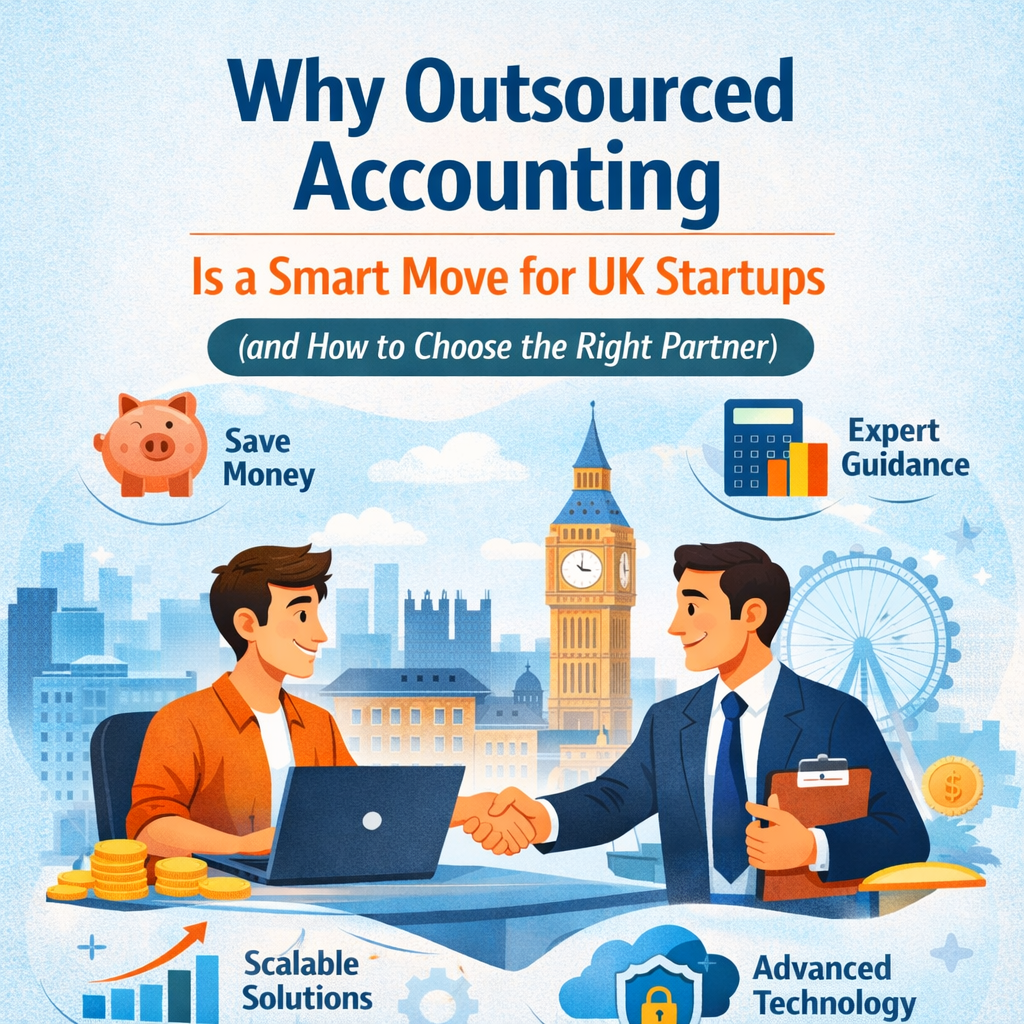
Why Outsourced Accounting Is a Smart Move for UK Startups (and How to Choose the Right Partner)
Why Outsourced Accounting Is a Smart Move for UK Startups (and How to Choose the Right Partner) Starting a business in the UK is an exciting journey — but managing your finances effectively shouldn’t hold you back. For many startups, especially in their early stages, handling accounting and bookkeeping in-house can become a major drain on time, money, and energy. That’s where outsourced accounting comes in — a cost-effective, flexible, and strategic solution that helps startups focus on growth. 1. Save Money — Without Sacrificing Quality For startups, every pound counts. Hiring a full-time accountant means paying salaries, benefits, pensions, training, software licenses, and often providing office space. Outsourced accounting lets you convert these fixed costs into flexible service fees. Instead of paying for a whole team, you only pay for the services you need — and often at a much lower cost. Outsourced providers often deliver professional expertise at a fraction of the cost of an internal team, helping save your startup tens of thousands of pounds annually — money that can be reinvested into product development, marketing, or scaling operations. 2. Gain Access to Specialist Expertise Startup founders are experts in their product or service — not necessarily in UK tax law, VAT regulations, or financial compliance. Outsourced accounting puts you in direct contact with professionals who specialise in accounting, taxation, and compliance. These experts stay up-to-date with complex UK financial regulations (like HMRC requirements and Making Tax Digital standards) and ensure your books are accurate, compliant, and audit-ready. This eliminates costly mistakes, missed deadlines, or penalties that can arise from inexperience. 3. Scalable Support That Grows With Your Business Startups grow fast — but their accounting needs don’t always follow a steady pattern. Some months require more support (e.g., tax season), while others are quieter. Outsourced accounting gives you the flexibility to scale services up or down on demand, without the burden of hiring or laying off staff. Whether you need basic bookkeeping at launch or advanced financial forecasting as you expand, your provider can adjust to your evolving requirements with ease. 4. Free Up Time to Focus on What Matters Time is one of the most precious resources a founder has. Every hour spent wrestling with spreadsheets or deciphering HMRC guidance is an hour taken away from product innovation, customer acquisition, or fundraising. With outsourced accounting handling the books, tax filings, payroll, and compliance, you can focus on your core business strategies and growth initiatives. 5. Leverage Advanced Accounting Technology Outsourcing accounting isn’t just about people — it’s also about technology. Reputable providers use leading cloud accounting platforms and automation tools (like Xero, QuickBooks, or FreshBooks) that most startups would find expensive or complex to implement in-house. These technologies improve accuracy, provide real-time financial insights, and enable seamless collaboration — all from anywhere with an internet connection. How to Choose the Right Outsourced Accounting Partner Not all providers are created equal. Here’s how to find one that fits your startup’s needs: Look for Industry Experience Choose a partner familiar with startup finances and UK regulations such as SEIS/EIS tax schemes, VAT, R&D tax claims, and more. Providers with this background can offer tailored advice, not just basic services. Prioritise Clear Communication Your accounting partner should explain numbers in plain English and keep you informed regularly — no jargon, no surprises. Consider Technology Compatibility Ensure they use cloud accounting tools you’re comfortable with. This ensures smooth data sharing, real-time updates, and secure access to your finances whenever you need them. Check for Scalability & Flexibility Your provider should offer services that grow with you — from early bookkeeping to advanced advisory support as your business scales. Assess Data Security Practices You’re trusting them with sensitive financial information. Ask about their data protection standards, encryption, and how they handle backups. Conclusion Outsourcing accounting is more than a cost-cutting tactic — it’s a smart strategic decision for UK startups that want to stay compliant, competitive, and focused on growth. By partnering with the right outsourced accounting provider, you get expert support, scalable services, and the freedom to dedicate your time to building your business. When done right, outsourcing your accounting isn’t just a smart move — it’s a growth accelerator.